

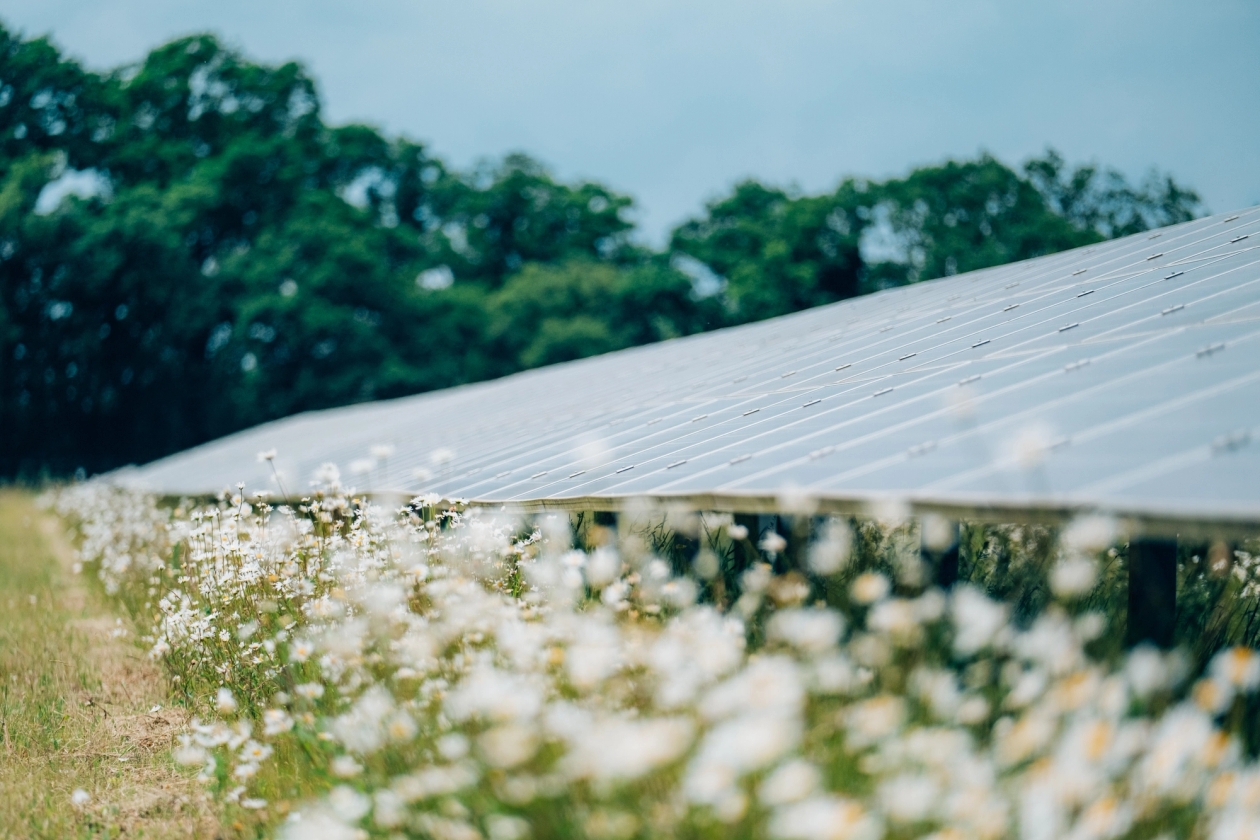
Low Carbon unveils early proposals for Somerset Energy Park
UK renewable energy company and Independent Power Producer (IPP), Low Carbon, has announced that it has begun developing proposals for Somerset Energy Park, a new solar project co-located with battery energy storage near the village of Mark, Somerset.
Somerset Energy Park has a potential capacity of 500 MW, and once built, will generate enough clean electricity each year to power the equivalent of more than 145,000 homes while avoiding around 150,000 tonnes of CO₂ emissions annually.
The project comprises five development areas – Northern, Eastern, Southern, Western and Central – with solar panels, a battery energy storage system and associated infrastructure, including inverters and substations.
The proposed development will include significant environmental mitigation and areas for biodiversity enhancement that will be designed in response to ongoing assessment.
The proposals for Somerset Energy Park also include connection and access infrastructure required to connect to the National Grid via the proposed Woolavington Substation. While at an early stage, Low Carbon has identified broad search areas for this infrastructure, with connections likely to include a mixture of overhead lines and underground cables, which will be refined as the design and assessment work progresses.
Low Carbon has begun engaging with local stakeholders, including communities, landowners, local authorities and statutory consultees, to build an understanding of the local area as the emerging proposals take shape. A wider public consultation is planned for early 2027, providing an opportunity for local communities and other interested parties to review the proposals and provide feedback.
Project Development Director at Low Carbon, Ed Perrin, said:
“Somerset Energy Park represents an opportunity to deliver new, home-grown renewable energy while building greater flexibility into the energy system through battery storage.
“Nature and the environment are the starting point for our design, so that ecological enhancements are built in from the very beginning of the project.
“Our priority is to develop a site that responds carefully to its surroundings and listens to the local community as we help deliver the clean, secure energy the UK needs for the future.”
With a generating capacity of more than 100 MW, the proposed development is classified as a Nationally Significant Infrastructure Project (NSIP). An application for a Development Consent Order (DCO) will be submitted to the Planning Inspectorate, with the consent determined by the Secretary of State for Energy Security and Net Zero, Miatta Fahnbulleh.
Low Carbon has recently announced its early proposals for two other large-scale solar projects co-located with battery energy storage, West Oxfordshire Energy Park and Dengie Peninsula Energy Park.